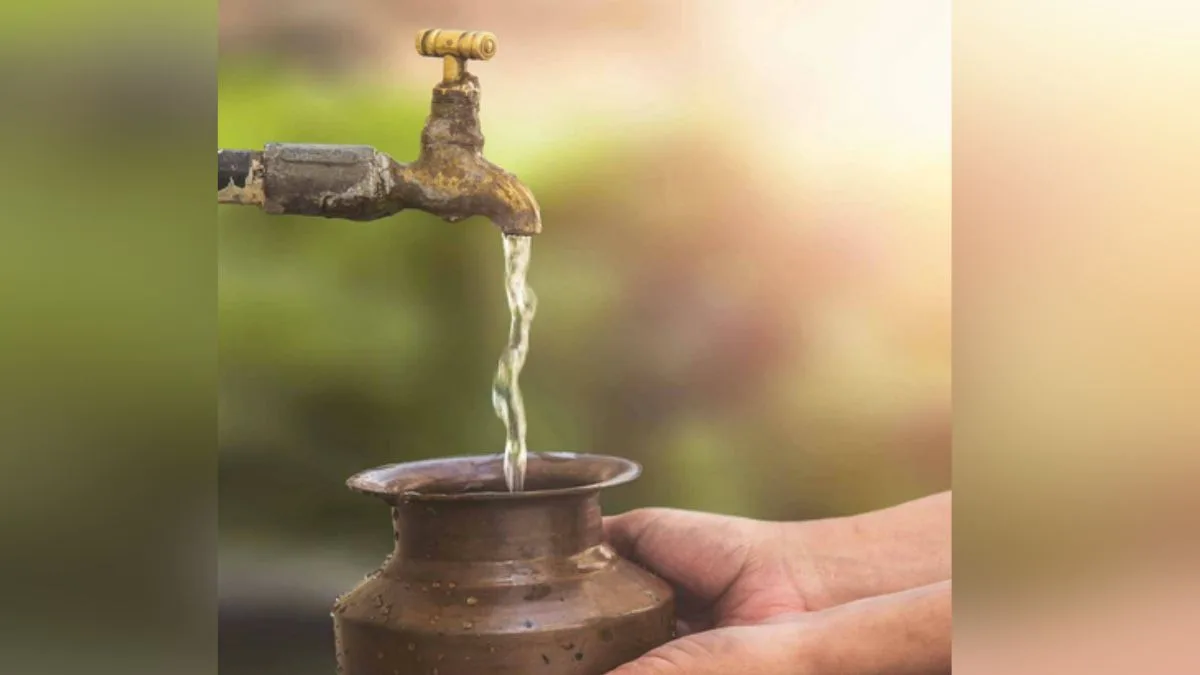
The Union Cabinet on Tuesday approved the extension and restructuring of the Jal Jeevan Mission, expanding the programme’s timeline to December 2028 and raising its overall outlay to Rs 8.69 lakh crore as the government shifts focus from infrastructure creation to long-term service delivery and governance reforms in rural water supply.
Briefing reporters after the Cabinet meeting, Minister of Information and Broadcasting Ashwini Vaishnaw said the proposal put forward by the Ministry of Jal Shakti seeks to transform the mission into a sustainable, service-oriented programme backed by stronger institutional mechanisms. “The Cabinet has approved restructuring and reorientation of the Jal Jeevan Mission from an infrastructure-centric approach to a service delivery model supported by a robust drinking water governance and institutional ecosystem,” he said.
Advertisement
Under the revised plan, the government approved a total programme outlay of Rs 8.69 lakh crore, including central assistance of Rs 3.59 lakh crore. This marks a significant increase from the Rs 2.08 lakh crore central allocation approved when the scheme was first launched in 2019–20, adding an additional Rs 1.51 lakh crore in central funding.
The revamped programme, often referred to as JJM 2.0, will introduce structural reforms aimed at improving the sustainability of rural drinking water systems. A key initiative under the new framework is the creation of a national digital platform called “Sujalam Bharat”, which will assign each village a unique “Sujal Gaon” or service area identification number and digitally map the entire drinking water supply network from source to household tap.
To improve transparency and accountability, the government plans to involve Gram Panchayats and Village Water and Sanitation Committees in the commissioning and handover of water supply schemes through a process called “Jal Arpan”. Under this system, a Gram Panchayat will declare itself “Har Ghar Jal” only after verifying that proper operation and maintenance mechanisms have been established within the village by the respective state government.
Officials also said the programme will promote a community-led initiative called “Jal Utsav”, an annual event designed to review and maintain water supply systems while encouraging local participation in the long-term sustainability of drinking water resources.
Launched in 2019, the Jal Jeevan Mission aims to provide functional household tap connections to every rural household in India.
Government data indicates that the scheme has significantly expanded access to piped drinking water since its inception. From a baseline of 3.23 crore rural households—around 17% of the total—with tap water connections in 2019, more than 12.56 crore additional households have been covered so far.
At present, out of 19.36 crore rural households identified by states and Union Territories, around 15.80 crore—about 81.61%—are reported to have access to tap water connections.
The government said the programme has also generated wider social and economic benefits. Studies cited by officials suggest that improved access to drinking water has reduced the burden of water collection on women and improved health outcomes in rural communities.
Research by the State Bank of India indicates that the scheme has freed nearly nine crore women from the daily task of fetching water, while estimates by the World Health Organization suggest it has helped prevent hundreds of thousands of diarrhoeal deaths and significantly reduced the time spent collecting water.
With the extension of the programme, the government aims to provide tap water connections to all 19.36 crore rural households by December 2028 and ensure that all Gram Panchayats across the country achieve “Har Ghar Jal” certification. Officials said the restructured mission will also promote stronger coordination across ministries to ensure long-term operation and maintenance of rural water supply infrastructure while securing sustainable water sources.
The reforms are part of the government’s broader development vision linked to Viksit Bharat 2047, which aims to establish reliable and continuous drinking water services in rural areas through a citizen-centric and utility-based approach to water management.